




Instant Sanitation Verification in Dairy Plants: ATP Bioluminescence Testing Protocol
The 48-hour incubation periods required by traditional microbiological testing loops directly compromise the critical shelf life of fresh dairy products. Halting production lines or executing blind startups while waiting for laboratory results exposes dairy plants to severe contamination hazards and product recall risks. Invisible biofilm layers and milk stones present constant hidden dangers within internal surfaces. CleanTrust® Hygiene Monitoring Solutions resolve this bottleneck by quantifying organic residues across all critical nodes—from raw milk reception to filling heads—in just 15 seconds, providing an objective, data-logged verification framework fully compliant with HACCP and ISO 22000 standards.
Related Products
1. Industrial Hazard: Invisible Biofilms and Organic Residues in Dairy Lines
In industrial dairy processing, knowing whether a production line is truly clean immediately following a Clean-in-Place (CIP) cycle is paramount. Microscopic accumulations of milk proteins, fats, and calcium-phosphate milk stones on stainless steel surfaces serve as ideal substrates for pathogen propagation. Biofilm layers rapidly organizing on these organic matrices continuously shed bacteria into the product flow, degrading milk quality. Standard visual inspections fail to detect these microscopic hazards, while conventional culturing methods are inherently too slow to provide actionable operational control.
2. Biochemical Mechanism: How ATP Bioluminescence Technology Works
Adenosine Triphosphate (ATP) is the universal energy molecule present in all living cells, dairy residues, bacteria, and organic matter. The underlying biochemistry of the CleanTrust® system replicates the natural bioluminescent reaction utilized by fireflies to emit light. As the specialized swab tip is passed across a surface, it collects all free and intracellular ATP molecules. Upon activation, the *Luciferase* and *Luciferin* reagents sealed within the swab device establish a highly selective bond with the collected ATP, triggering an instantaneous light-emitting reaction. The intensity of the generated light is directly proportional to the amount of organic residue present. CleanTrust® Luminometers capture this photon flow digitally, converting it into a clear, numerical value expressed in RLUs (Relative Light Units) within seconds.
3. Standard Operating and Correct Swabbing Procedure in the Field
To secure maximum precision, repeatability, and cross-batch data stability from the CleanTrust® matrix, plant operators should systematically follow these standard testing steps:
| Step | Operational Phase | Technical Details & Correct Field Execution |
|---|---|---|
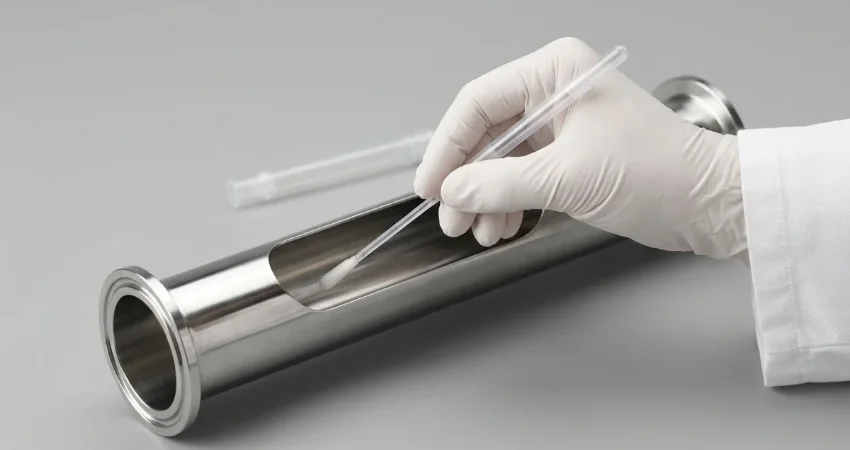
| Step 1 | Surface Swabbing | Remove the pre-moistened CleanTrust® swab from its protective tube. Pressing firmly onto the selected 10x10 cm critical surface area, sweep the tip across the surface in crosswise zigzag patterns while rotating the swab shaft to ensure complete contact. |
| Step 2 | Device Activation | Reinsert the swab fully into its plastic sleeve. Firmly bend the patented plastic snap-valve mechanism at the top of the device left and right until it breaks completely. This releases the liquid reagent from the top reservoir into the base of the tube. |
| Step 3 | Mixing and Reaction | Gently shake the swab device in a vertical axis for 3 to 5 seconds to ensure the liquid completely coats the collected sample on the tip. This uniformly initiates the enzymatic ATP-to-light bioluminescent reaction loop. |
| Step 4 | Luminometer Insertion | Immediately insert the activated CleanTrust® device vertically into the dedicated reading chamber of the CleanTrust® Touch or Plus luminometer. Close the chamber lid completely to create an absolute light-tight seal. |
| Step 5 | Measurement and Verification | Press the "Run Test" button on the interface. Following a 15-second digital countdown, the precise RLU data is displayed on screen. Based on user-defined target thresholds, the system instantly logs a "Pass / Warning / Fail" verdict for line validation. |
*Note: Periodic validation and calibration checks of the luminometer optics using the optional CaliRod 01 Calibration Rod are highly recommended to support strict compliance with GMP and external food safety audit standards.
4. Aligning Specific Test Kits with Dairy Process Points
Selecting the optimized test variant according to the physical nature of the target dairy monitoring point is essential for ensuring absolute measurement accuracy:
- General Lines and Bulk Tanks: Use the moisture-resistant ATP Surface Swab (YL0002) designed for standard stainless steel processing vessels and internal piping lines.
- Critical High-Risk Control Nodes: For high-risk areas such as filler heads and valve gaskets, utilize the chemical-resistant ATP Surface MagniSwab (YL0012), which delivers 5 times higher baseline sensitivity.
- CIP Rinse Water and Fluid Lines: Deploy the ATP WaterTotal Swab (YL0004) to measure total organic and microbiological loads in final rinse water lines, or the ATP WaterFree Swab (YL0003) to differentiate extracellular free ATP in specialized liquid samples.
- Allergen and Protein Trace Tracking: To screen thermal lines for allergenic milk protein traces, utilize the Surface Protein Test Swab (YL0100) for visual color-metric verification at room temperature, or the ultra-sensitive Allergen Test Swab (YL0200) operating alongside a mini dry-block incubator.
Related Product Group
ELABORIC
CleanTrust® Hygiene Monitoring Solutions
ATP Surface Swabs & Industrial Handheld Luminometer Series